
Buying a vehicle is a major financial decision, and one of the most important documents you will receive at a dealership is the purchase agreement.
This document can contain the vehicle price, financing terms, taxes, fees, warranties, optional products, trade-in information, and other terms that can significantly affect what you ultimately pay.
Unfortunately, purchase agreements can be difficult to understand. Numbers may be spread across multiple sections, optional products may be presented alongside required charges, and the monthly payment may not tell you the full cost of the transaction.
At DealHelp.org, our goal is to help consumers understand what they are signing before they finance, lease, or purchase a vehicle.
Here is what to look for when reviewing a dealership purchase agreement.
1. Start With the Vehicle Price
The first number to examine is the actual selling price of the vehicle.
Make sure the agreement reflects the price you negotiated with the dealership.
Look for:
- Vehicle selling price
- Manufacturer or dealership discounts
- Rebates
- Dealer discounts
- Trade-in allowance
- Any adjustments to the agreed price
If you negotiated a vehicle for $30,000, but the agreement shows a higher selling price with a discount somewhere else, make sure you understand exactly how the numbers work.
A discount is not necessarily a problem, but you should be able to clearly identify the actual price you are paying for the vehicle.
2. Check for Dealer Fees
Dealerships may charge various fees depending on the vehicle, dealership, province, and transaction.
Examples can include:
- Administration fees
- Documentation fees
- Licensing fees
- Registration fees
- Freight or delivery charges
- Inspection fees
- Other dealer charges
Don't simply assume that every fee is mandatory.
Ask the dealership:
"What is this fee for, and is it required?"
If a fee was not discussed during negotiations, ask for an explanation before signing.
3. Separate Government Charges From Optional Products
One of the most important things to understand is the difference between required charges and optional products.
Your agreement may contain items such as:
- Sales tax
- Licensing
- Registration
- Extended warranties
- Appearance protection
- Rust protection
- Tire and rim protection
- GAP protection
- Theft protection
- Insurance products
- Maintenance packages
- Other protection plans
Some charges may be required by law or necessary to complete the transaction. Others may be products being offered by the dealership.
Do not assume that something listed on the purchase agreement is automatically mandatory.
If you don't understand a charge, ask:
"Is this required to purchase the vehicle, or is this an optional product?"
4. Look Carefully at Optional Add-Ons
This is one of the areas where consumers can sometimes find significant additional costs.
A dealership may offer products designed to provide additional protection or convenience. Some can be useful, but that doesn't mean every product is right for every buyer.
For example, an extended warranty might cost several thousand dollars.
A tire and rim protection package might add hundreds or thousands of dollars.
GAP protection may also be offered, particularly when financing a vehicle.
Before accepting an add-on, ask:
- What does it cover?
- How much does it cost?
- How long does it last?
- What exclusions apply?
- Who provides the coverage?
- Can I cancel it?
- Is it already included elsewhere?
- Is the product actually necessary for me?
Most importantly, make sure you know whether the price of the product is being added to your loan.
A $2,000 optional product financed over several years can cost more than $2,000 once interest is included.
5. Don't Focus Only on the Monthly Payment
One of the easiest ways to misunderstand a vehicle purchase is to focus exclusively on the monthly payment.
A salesperson might say:
"We can get your payment down to $499 per month."
That sounds straightforward, but the payment alone doesn't tell you what you are paying.
A lower monthly payment can sometimes be achieved by:
- Extending the loan term
- Increasing the down payment
- Changing the interest rate
- Adding or removing products
- Changing the amount being financed
- Changing the vehicle price
Instead, look at the total amount financed, interest rate, loan term, and total cost of borrowing.
A $499 payment over 84 months is very different from a $499 payment over 60 months.
6. Find the Interest Rate
If you're financing the vehicle, locate the annual interest rate, often referred to as the APR.
For example:
Interest rate: 8.99%
Make sure you understand whether the rate shown on your documents matches what you were told during negotiations.
Also look at the loan term.
For example:
84 months
A longer loan can make the monthly payment appear more affordable, but you may pay significantly more interest over the life of the loan.
7. Find the Total Amount Financed
The amount financed is the amount you are actually borrowing.
It may include more than just the price of the vehicle.
For example:
Vehicle price: $30,000
Taxes and fees: $4,000
Optional products: $3,000
Down payment: -$5,000
Trade-in credit: -$7,000
Amount financed: $25,000
The exact calculation will depend on the transaction.
The important thing is to understand how the dealership arrived at the amount being financed.
If you were expecting to finance $20,000 and the agreement shows $27,000, stop and ask questions before signing.
8. Review Your Trade-In
If you are trading in another vehicle, carefully review the trade-in section.
Look for:
- Trade-in allowance
- Outstanding loan balance
- Payoff amount
- Equity or negative equity
- Any deductions
- Amount applied toward the new purchase
Negative equity deserves particular attention.
For example, if your current vehicle is worth $15,000 but you owe $20,000, you have approximately $5,000 in negative equity.
That $5,000 may be added to the financing on your new vehicle.
This means you could be financing the new vehicle plus debt from your previous vehicle.
9. Verify the Down Payment
Make sure the down payment shown on the agreement matches what you actually agreed to pay.
If you provided a deposit earlier in the transaction, verify that it has been properly credited.
For example:
Deposit: $1,000
Additional down payment: $4,000
Total down payment: $5,000
If the numbers don't match your understanding, ask for an explanation.
10. Check the Taxes
Sales tax can represent a substantial portion of the transaction.
Review the applicable taxes and make sure you understand how they were calculated.
Your province, vehicle type, trade-in, and other circumstances can affect the calculation.
If the tax amount appears significantly different from what you expected, ask the dealership to explain the calculation.
11. Compare the Agreement With What You Negotiated
This is one of the most important steps.
Before signing, compare the final agreement against the numbers you originally discussed.
Check:
- Vehicle price
- Trade-in value
- Down payment
- Interest rate
- Loan term
- Monthly payment
- Optional products
- Fees
- Taxes
- Amount financed
A deal can change between the initial negotiation and the final paperwork.
The final document is what you need to understand before signing.
If something changed, ask why.
12. Be Careful When You're Told "It's Only $X Per Month"
Monthly-payment negotiations can make it difficult to see the bigger picture.
Suppose you are told:
"It's only $50 more per month for the protection package."
That may sound inexpensive.
But $50 per month over 72 months equals:
$3,600
And if the product is financed, interest may increase the total cost further.
Always convert monthly costs into their total cost over the term of the agreement.
13. Understand What Happens to Optional Products if You Cancel
Some products may have cancellation provisions.
However, cancellation does not necessarily mean that you receive a cheque for the full amount you paid.
Depending on the product and agreement, a cancellation may result in a refund being applied to your loan balance rather than paid directly to you.
There may also be cancellation deadlines, administrative requirements, or prorated refunds.
Before purchasing an optional product, ask for the cancellation terms in writing.
14. Watch for Duplicate Coverage
Sometimes consumers purchase products without realizing they already have similar coverage.
For example, you may already have:
- Manufacturer warranty coverage
- Insurance coverage
- Roadside assistance
- Credit insurance
- Other protection through an existing policy
Ask what additional protection a product actually provides.
The question isn't simply:
"Is this a good product?"
Instead ask:
"What does this product provide that I don't already have?"
15. Don't Sign Until You Understand It
You are not required to understand every legal or financial term immediately.
If something doesn't make sense, ask the dealership to explain it.
You can say:
"I'd like to review this before I sign."
You can also ask for a copy of the documents so you can review them carefully.
If you feel rushed, pressured, or uncomfortable with the transaction, consider taking a step back.
A vehicle purchase is a significant financial commitment. Taking additional time to understand the agreement can be worthwhile.
A Simple Purchase Agreement Review Checklist
Before signing, make sure you can answer "yes" to these questions:
- Do I know the actual selling price of the vehicle?
- Do I understand every dealer fee?
- Do I know which products are optional?
- Have I reviewed all warranties and protection products?
- Do I know the interest rate?
- Do I know the loan term?
- Do I know the total amount being financed?
- Does the down payment match what I agreed to?
- Does my trade-in value match the negotiated amount?
- Do I understand any negative equity being carried into the new loan?
- Do the taxes and fees make sense?
- Does the final agreement match the deal I negotiated?
- Do I understand the total cost of the vehicle?
- Do I have a copy of everything I'm signing?
If you cannot confidently answer these questions, consider asking for clarification before signing.
What If You Already Signed?
If you've already signed a purchase or financing agreement and are concerned about something you didn't understand, don't panic.
Start by collecting all of your documents, including:
- Purchase agreement
- Bill of sale
- Financing agreement
- Lease agreement, if applicable
- Warranty documents
- Protection-product contracts
- Trade-in paperwork
- Any emails, texts, or other written communications
Review the documents carefully and identify exactly what concerns you.
Depending on your province and the circumstances of the transaction, different consumer-protection rules and cancellation rights may apply.
If you believe something was misrepresented or you were pressured into purchasing a product you did not want, consider contacting your provincial consumer-protection authority or obtaining independent legal advice.
DealHelp.org Can Help You Understand Your Deal
Car dealership paperwork can be complicated, particularly when a vehicle purchase, trade-in, financing, and multiple optional products are combined into one transaction.
DealHelp.org is a free consumer resource designed to help people better understand vehicle purchase and financing agreements.
You can use our AI assistant to ask questions about your deal, upload your agreement for an add-on check, and build your loan file. A volunteer advisor may also be available to assist when possible.
Our goal isn't to tell you whether you should buy a particular vehicle or use a particular dealership.
Our goal is simple:
Help you understand what you're signing before you commit.
If you're about to finance, lease, or purchase a vehicle, take the time to understand the numbers—not just the monthly payment.
Know the price. Know the financing. Know the add-ons. Know what you're signing.
HOW IT WORKS
Get assistance with your deal
from Ai and real volunteers.
Ai Chat Assistant
Ai Chat + Volunteer Assist
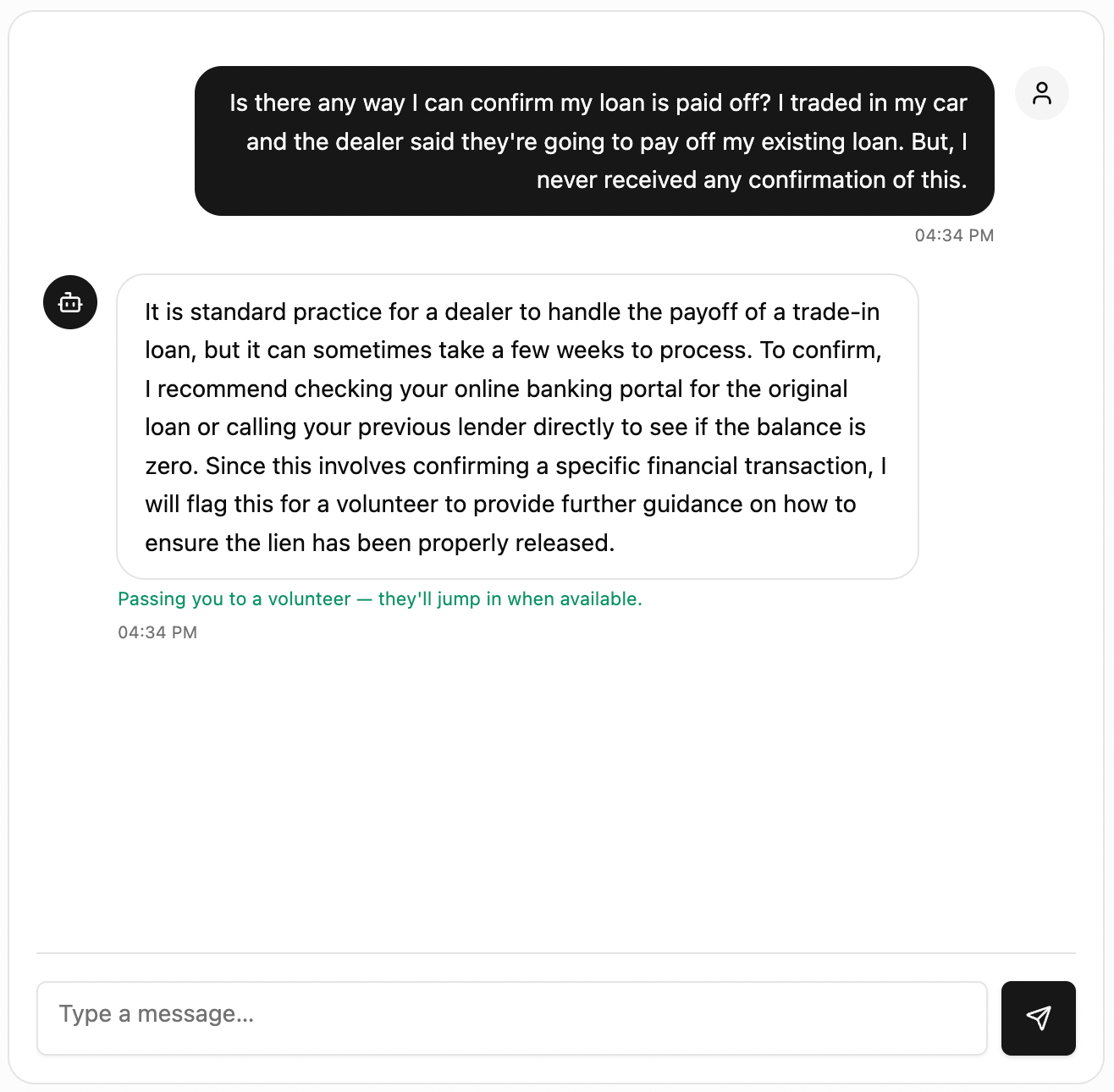
Ask anything about financing, leasing, or buying with cash. If needed, it will pass you to a volunteer and they'll jump in when available to assist further.
Ai Document Review
Ai Documents + Volunteer Assist
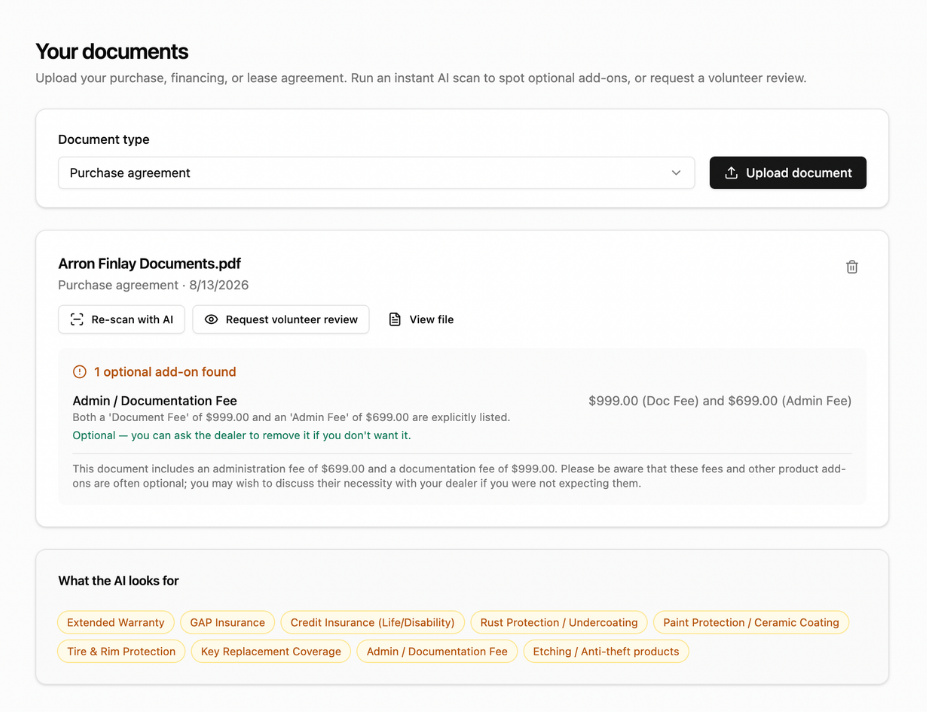
Upload your purchase, financing, or lease agreement. Run an instant AI scan to spot optional add-ons, or request a volunteer review.
Loan File Builder
Build Your Loan File
Build a quick profile so the AI assistant and volunteers can give you tailored guidance. You can edit this anytime.